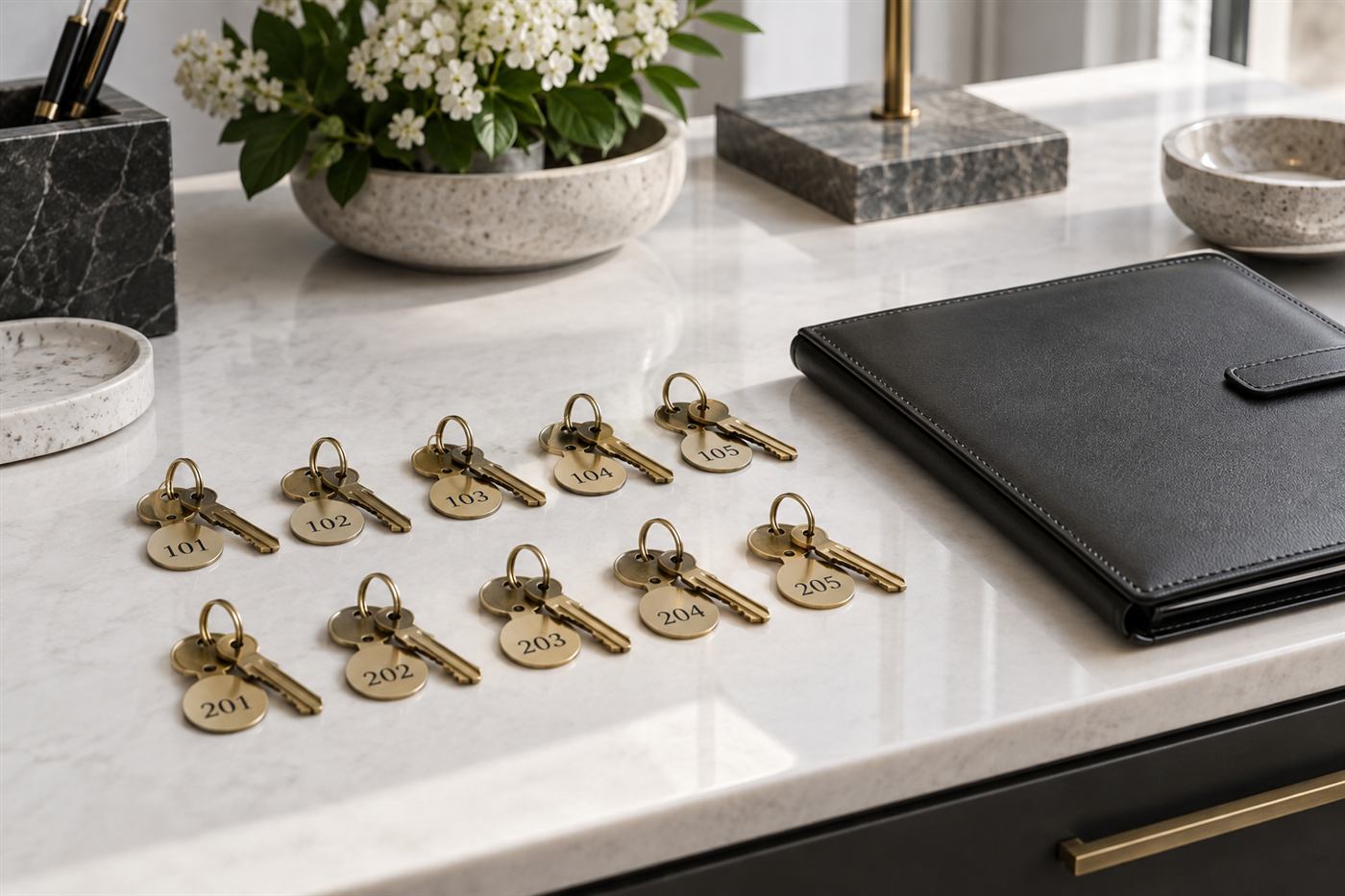
What keyed alike means
Keyed alike means that two or more locks are set up to work with the same key. Inside each lock cylinder is a row of small pins of different heights. When the correct key is inserted, its cuts raise each pin to exactly the right level and the cylinder can turn. To key several locks alike, a technician sets the pins in every cylinder to match the same pattern of cuts, so one key lifts all of them correctly.
This is different from keyed different, which is the normal arrangement where each lock has its own unique cut pattern and a key only fits its own lock. It is also different from a master key system, in which every lock still has its own key but a higher-level key opens a defined group. If you want to understand how those layers work, our master key system planning guide describes them in plain terms.
In a home, keyed alike is usually a convenience. Instead of a front door key, a back door key, a garage entry key and a side gate key, you carry one. Locksmiths do this regularly, either when new locks are installed or by rekeying existing ones. If you are curious about the mechanical process, read how rekeying works for a step-by-step description of what happens inside the cylinder.
Why homeowners choose it
The main reason is simplicity. Many people carry a bundle of keys they cannot sort without looking. A single key that opens every exterior door in the home reduces fumbling at the door, particularly in the dark, in the rain, or with groceries in your arms. It is also helpful for family members who would otherwise need a full ring, such as children, grandparents or a house sitter who needs access to multiple entrances.
Another reason is the cost of duplicates and the effort of tracking them. With one key pattern, you need only one type of spare. If you give a key to a neighbor or a caregiver, they receive a single key that does what they need rather than three. If a key breaks or wears out, a replacement is a single cut. Keeping fewer key types in circulation can make household organization easier.
Keyed alike is also popular during lock replacement projects. When a homeowner buys new deadbolts for all the exterior doors, a locksmith can set them up as a matched set so they work with the same key from the start. That is often simpler than buying separate locks and later trying to match them. See lock replacement for how that work is handled.
The tradeoffs you accept
The tradeoff is concentration of risk. If a keyed alike key is lost, stolen or copied by someone who should not have it, every door that key opens is affected at once. With separate keys, a lost garage key does not affect your front door. With one key, a lost key can mean rekeying or replacing several locks, not just one. That risk is manageable, but it should be a conscious choice.
The second tradeoff is control. Giving someone a key for the back door, such as a landscaper or pool service, also gives them a key to the front door if the locks are alike. Many homeowners solve this by keying only some doors alike and keeping others separate, or by using a lockbox or smart lock for service workers. You decide how much access each person needs and key the doors accordingly.
The third tradeoff is that the benefit depends on discipline. A single key makes it tempting to hand out copies casually. Keep a list of who has a key, and do not leave spares with people whose circumstances might change without a plan to collect them. If you are unsure how many keys exist, rekeying resets the count. For a deeper discussion, see rekey versus replace.
Which doors are good candidates
Doors that belong to one household and are used by the same people are the best candidates. The front door, the back door, the garage entry door, a lanai or patio door and a side entry are typical choices. All are used by the family, and carrying one key for them is a real convenience. A detached garage or pool house can fit this group if the same people use it.
Think carefully about doors that others use. A casita rented to a guest, an in-law suite or an office suite used for business should usually be keyed separately. The same is true for a storage room that holds valuables, a gun safe room or a home office with records. A separate key lets you control who can enter each area without handing over the whole house.
Gates and mailboxes deserve a decision too. A pool gate that children use can be keyed alike with the house, but be careful about giving a gate key to everyone who uses the pool. A mailbox key is usually set by the post office or the building and cannot be changed to match your other locks. Our pages on mailbox lock service and gate lock and latch service explain what can be changed.
Brands, keyways and what can be matched
Locks can be keyed alike only if they use the same type of keyway, which is the shape of the slot where the key enters. Many common residential brands share compatible keyways, and a technician can often match different brands by rekeying them to a common pattern. Others use proprietary keyways, so a lock from one maker cannot be made to work with a key from another.
Some locks are not suitable at all. A very inexpensive lock may use a basic cylinder that cannot be rekeyed, and a decorative lockset may lack the parts needed. Smart locks and keypads sometimes use a standard cylinder behind the electronics, which can be matched, and sometimes use a proprietary one. Before you buy a new lock with the plan of matching it, check that it accepts the keyway you want.
High-security and restricted keyways add another layer. They are designed so that blanks are controlled and copies need authorization. Many homeowners like that idea for exterior doors, and it works well with keyed alike sets. See high-security cylinders for how those systems differ from standard ones. A technician can look at each lock and tell you what can be matched.
Keyed alike after a move or a life change
A move is a natural moment to consider keyed alike locks. When you take over a home, you do not know how many keys exist, and the previous owners, agents, contractors and neighbors may all have had one. Rekeying every exterior lock to a single new key resets access and simplifies your life at the same time. Our moving day lock checklist shows where this step fits.
Other changes matter, too. A separation, the end of a roommate arrangement, a falling-out with a former employee, or the loss of a wallet can all be reasons to change who holds keys. If your locks are already keyed alike, one rekey of the set resets everything. If they are separate, you might have to rekey several locks individually, though the result can be a more streamlined set.
If you rent out part of your property, consider a layout that keeps your own doors keyed alike while the rental unit has its own key. That way a tenant's key never opens the main house, and when a tenant leaves you rekey only their door. It is a simple design that avoids many headaches. For landlord-specific guidance, see landlord lock responsibilities.
Living with a keyed alike set
A few habits keep the set working well. Make a small number of spares, store them in a safe place and write down who has each one. Label keys with a neutral tag, not your address. If a key is lost, decide quickly whether it can be recovered. If it cannot, rekey all the locks together, which is generally efficient because the technician can reset every cylinder in one visit.
Watch wear. Keys that are copied from copies lose accuracy, and a worn key can begin to stick or fail. Cut spares from the original key, not from a worn duplicate. Our page on spare key duplication explains the difference. If a key has started to feel rough, replace it before it fails.
Keep a simple list of every lock in the set: door name, brand and any notes. If you later add a door, such as a new shed, a gate or a garage side door, the list tells the technician what to match. Our guide to keeping keys organized has more ideas for managing a household key set.
When separate keys make more sense
Keyed different is the better choice in several cases. If you have service workers who need access to a specific door, separate keys limit what they can reach. If a door protects something important, such as a home office, a wine room or a safe room, a separate key adds control. If you have a large household with different needs, separate keys let you assign each person access to what they need.
It is also the better choice when a lock is old or poor quality and cannot be rekeyed. In that case, replacing the lock with a better one gives you the choice again. For rentals, vacation properties and shared buildings, each unit should generally have its own key, and the building may use a master key system on top. See townhome and villa locks for examples where shared walls and common areas change the picture.
There is no single right answer. Think about who needs access, what could go wrong if a key is lost, and how much convenience you value. A mixed approach, with a few doors keyed alike and a few separate, is common and often the best fit. A technician can set up whichever combination you prefer.
Deciding and taking the next step
Start by listing your doors and who uses each one. Mark the doors that belong to the household as one group, and mark doors with outside users separately. Decide how much risk you accept if a key is lost. If you are comfortable with one key for the family doors, a keyed alike set is a good fit. If not, choose a smaller group or keep them separate.
When you are ready, call and describe your doors, the brands if you know them, and what you want to achieve. The technician will tell you whether the existing locks can be matched or whether some should be replaced. Quotes are given only by phone, and a service call charge applies, which is explained before dispatch. A short visit can usually convert a home's doors to a matched set.
Questions people ask
What does keyed alike mean?
It means that two or more locks are set up so that one key opens all of them. A technician sets the pins inside each cylinder to match the same cut pattern. It is different from a master key system, where each lock has its own key and a higher-level key opens a group. In a home it is mainly a convenience.
Can I key my existing locks alike?
Often yes. If the locks are rekeyable and use compatible keyways, a technician can rekey them to match. Some very basic or decorative locks cannot be rekeyed, and some brands use proprietary keyways that do not match others. A technician can check each lock and tell you what can be matched and what should be replaced.
Is keyed alike less secure than separate keys?
Not in itself, but the risk is concentrated. If one key is lost or copied, every door it opens is affected. With separate keys, a lost key affects only one door. Many households accept that tradeoff for the convenience, and others key only some doors alike. It is a choice about risk and convenience.
Should the garage side door match the front door?
Many homeowners do this for convenience, since the same people use both doors. If workers or guests use the garage entry, consider whether you want them to have a key that also opens the front door. If so, keep that lock separate, or use a lockbox or keypad lock for the garage entry.
What do I do if a key to a keyed alike set is lost?
Decide whether it can be recovered. If not, rekey the whole set, which resets every lock to a new key and makes the lost one useless. Rekeying all the locks together is usually efficient, because the technician can do them in one visit. Check the doors for signs of entry if you suspect theft.
How do I get a quote for keying my doors alike?
Quotes are given only by phone. Call, tell the technician how many doors you have and what brands of locks are on them, if you know. The technician will say whether the work can be done in one visit or needs an on-site look first. A service call charge applies and is explained on the phone before dispatch.
Describe the situation by phone and we will tell you what the job involves. Quotes are given by phone. Jobs that cannot be quoted without seeing them need a technician on site, and the service call charge is explained on the phone before anyone is dispatched.
(954) 906-9567Related pages
Planning the work for a keyed alike set
Making several locks accept one key starts with a decision about which locks are staying and which are going. A technician usually asks you to list every door that should be on the set and to identify the brand and condition of each lock. Locks of the same brand are often simplest, because the cylinders can be pinned to match. When brands differ, one option is to adapt cylinders on some doors, another is to replace a few locks so everything fits together. Knowing this before work begins avoids surprises. Photos taken on your phone can be a useful reference, especially if you need to share the details with a landlord, manager, or family member.
The next step is choosing the key to match. You can pick an existing key that already works in one lock, or have all the cylinders set to a new key. Starting from a new key is common after a move, since it also cuts off anyone who held the old one. The technician removes each cylinder, changes the internal pins to match the chosen key, reassembles it, and tests it. Every door should be tested from both sides with the door open and then closed. Think about who else relies on the door, including relatives, caregivers and service people, before you change how it works.
Prepare by gathering all existing keys, including the ones you rarely use, and by clearing access to every door involved. Tell the technician about any lock that has been sticking, since it may be better replaced than rekeyed. The scope and any quote are explained before work begins, so you can decide which doors are included. If you later add a door, the new lock can usually be set to the same key, which is one benefit of planning the system carefully. A steady, methodical approach nearly always beats a quick fix when locks and doors are involved.
Keeping control of a single key
A single key is convenient because it is also a single point of failure. If that key is lost, every door it opens is affected, and so the habits around it matter more than usual. Decide how many copies exist and who holds them, and keep a written count. Avoid attaching an address or any identifying label to the key ring. A modest approach is to have a primary set that stays with you and one spare in a secure place, rather than many copies scattered around. Windy afternoons and sudden storms are common in this region, so doors that close firmly on their own deserve extra attention.
Think about doors where you might not want everything to be shared. Many households keep the shed, a workshop, or an office on a separate key, and key the main doors alike. That keeps casual access, such as a babysitter coming in the front door, from becoming access to everything. A restricted keyway, available on some lock lines, can also limit unauthorized duplication, because blanks are controlled and copies require authorization. Check both sides of the door, since a problem that shows on the inside is sometimes caused by something on the outside.
If a key is lost, treat it as a prompt to re-key the whole set to a new key, which is easier when the set is already alike. The technician can remove the cylinders and change them all in one visit. You will end up with a fresh key and the same convenience as before. The scope and any quote are explained before the work begins, and you can ask whether any lock is worn enough to deserve replacement while it is out. Once you have finished, test the result several times in a row to make sure it holds up in everyday use.