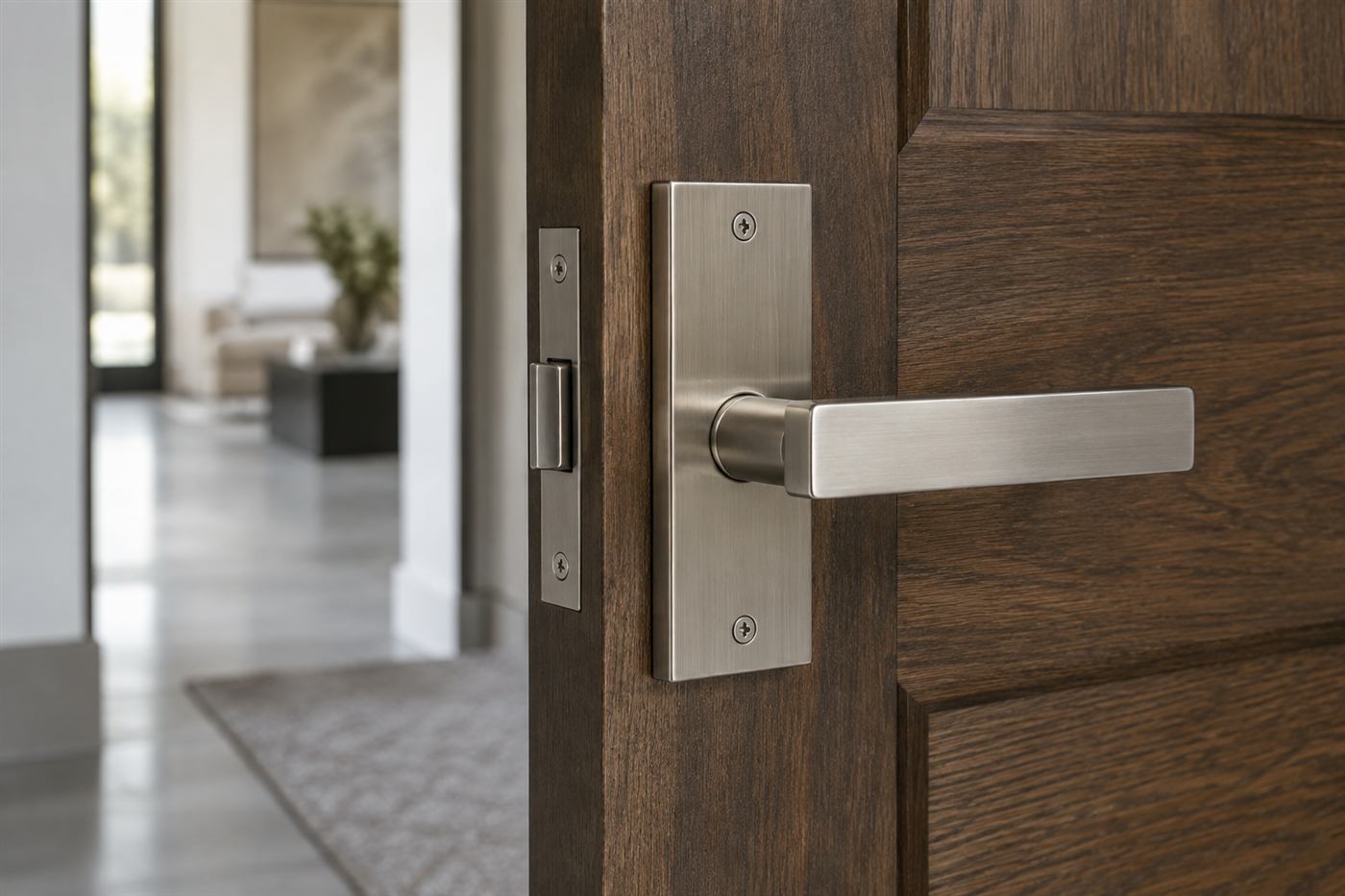
Why gate hardware fails faster than door hardware
A front door lock lives in a sheltered frame with a weather seal and a roof overhead. A gate latch hangs on a post or a rail, fully exposed. Rain, sprinkler overspray, morning dew and the salt that drifts inland from the Atlantic all land directly on the metal. Add Florida sun that heats a dark powder-coated bracket until it is too hot to touch, and you have a part that expands, contracts and corrodes every single day.
The mechanical load is also harsher. Doors are opened by people who understand them. Gates get kicked, pushed with a hip while carrying groceries, swung by children, hit by a lawn mower, and slammed by wind. A self-closing gate adds a spring that drives the latch into the strike thousands of times. Even a well-made latch has a finite number of those cycles in it.
That is why a gate lock call is rarely about one dramatic failure. It is usually the end of slow wear: a tongue that no longer reaches the catch, a keyed cylinder that turns with grit in it, a post that has shifted a quarter inch so the two halves of the latch no longer meet. Understanding which of those you have decides whether the fix is an adjustment, a part, or a full replacement.
The main types of gate locks and latches
Most residential gates in Boca Raton and the surrounding towns use one of a handful of designs. Knowing yours helps you describe the problem on the phone, which helps the technician bring the right parts on the first visit.
- Gravity latch. A bar or lever that drops into a catch. Simple, common on wood and aluminum fence gates. It has no key and no spring, so it fails when the pivot corrodes or the catch bends.
- Thumb latch. A lever you press to lift a bar from a keeper. Often seen on wooden side gates. The thumb piece and bar wear at the pivot.
- Self-closing, self-latching pool gate hardware. A spring hinge pulls the gate shut and a magnetic or mechanical latch catches automatically. Many have a key option or a lockable knob on the inside.
- Keyed gate lock. A surface-mounted or mortise lock that takes a key on at least one side. Used on side yards, service gates and storage enclosures.
- Drop bolt or cane bolt. A rod that drops into a hole in the ground or a sleeve in a post, typically on the second leaf of a double gate.
- Keypad or electronic gate lock. A battery-operated or wired lock with a keypad. These are sealed units that must be rated for outdoor use.
Pool gates: a safety device first and a lock second
Around a pool, the gate is a life-safety barrier. The point of a self-closing, self-latching gate is that it works even when everyone forgets, including the guest who props it open with a flip-flop. If the latch no longer catches on its own, the gate is not doing the job it exists to do, and a young child can be at the water before anyone notices.
General expectations in Florida are that a pool barrier closes and latches by itself and that the release is placed out of a small child's reach. The exact rules depend on the type of pool, the age of the home and the local building office, so a technician will not quote a rulebook from memory. What a locksmith can do is restore the closing and latching function so the gate behaves the way the hardware was designed to behave.
If your pool gate drags on the ground, swings shut slowly, or only latches when you push it, treat it as urgent. Keep the area supervised until it is repaired, and keep the gate physically held closed in the meantime if you can do so safely. A pool gate that has failed to latch for weeks is a quiet risk, and it is one of the simplest hazards in a yard to fix.
Salt air, humidity and sprinklers
Corrosion is the leading cause of gate hardware replacement along the coast. Zinc-plated and low-grade steel parts bloom white or red within a season near the water. Stainless steel resists much better, though not perfectly, and it still benefits from rinsing. Aluminum and brass tolerate the climate but can pit and seize at screw points where two different metals touch.
Sprinklers deserve more blame than they get. A head that sprays across a latch every morning keeps the mechanism wet for hours, which is worse for a keyed cylinder than an occasional storm. Rotating the head or redirecting the nozzle is sometimes the most valuable repair, and it costs nothing in hardware.
A technician will look at the metal, the finish, and the pattern of staining to judge what failed. Rust running down from a screw head means the fastener, not the latch, is the culprit. A cylinder that turns stiffly only in the morning points to moisture, not wear. Matching the fix to the cause keeps you from replacing the same part again in a year.
What you can check yourself before calling
A few observations are safe, take two minutes, and make the phone call more useful. None of them involves taking the lock apart.
Close the gate slowly by hand and watch where the latch tongue meets the catch. If it lands above, below or beside the opening, the gate has sagged or a post has moved. Look at the hinges: a loose or worn hinge lets the swinging edge drop, and no latch will cope with that for long. Check whether the gate swings smoothly or rubs the ground, a post or a plant.
Look at the strike or catch for bent metal, loose screws or a crack in the post. Check whether the key goes in smoothly and turns without force. Never spray oil into a keyed gate lock, because oil collects grit and turns into paste in dusty conditions. A small amount of dry graphite or a lock-specific dry lubricant is safer, and if the lock is already stiff, leave it for the technician rather than forcing the key.
Take a photo of the latch from both sides and of the whole gate closed. Photos let the technician identify the make and size, which sharply improves the chance of finishing in one visit.
What a technician does on site
The visit starts with diagnosis, not with a replacement part. The technician will operate the gate several times, note where it binds, and check the alignment of the hinges, the post and the catch. Many latch complaints are alignment problems, and the repair is shimming, adjusting a hinge, resetting a post bracket or moving the strike a fraction of an inch.
If the hardware itself is worn out, the next question is what to replace it with. For pool gates the choice is usually a self-closing, self-latching unit built for outdoor and marine use, with stainless or similarly resistant components. For keyed side gates it may be a heavy-duty surface lock with a weather cover. For wood gates, the screws and the wood matter as much as the lock, because a latch cannot hold in rotted material.
The technician will test the finished result by closing the gate from several distances and angles, since a latch that catches when pushed gently may miss when the gate swings fast. Keys are cut or the lock is keyed to match others on the property where that is possible. Complicated jobs, such as a double gate with a hidden drop bolt or a gate set into masonry, may need an on-site visit before any quote can be given.
Keyed alike, rekeyed or combination: choosing how the gate is opened
A gate lock is only useful if the right people can open it easily. Rental properties, pool service providers, landscapers and delivery drivers all need access at different times, and handing out copies of the same key to all of them creates a problem you cannot undo.
Keyed alike hardware lets one key open the gate, the shed and the garage side door, which is convenient for a single household. Where several outside parties need access, a combination or keypad gate lock can be easier to manage, because you change the PIN rather than recovering keys. The tradeoff is that PINs get shared casually and batteries need attention, so keypad units suit properties where someone checks them regularly.
If you have lost track of who holds a key to the gate, the cleanest fix is to rekey the lock or replace the cylinder, so old keys no longer work. You can read more about how that works on our rekeying service page. If the gate leads to a garage or house entry, consider whether the same plan should cover the garage entry door too, because a locked gate that opens onto an unlocked door is only half a barrier.
Gate locks for different kinds of properties
A single-family home in Boca Raton may have a short side gate, a pool fence and possibly a decorative front courtyard gate. Each has different needs. The side gate needs reliable latching and a lock that homeowners can operate with one hand while carrying things. The courtyard gate may be mostly cosmetic, so appearance and finish matter more. The pool gate needs the strongest self-closing and self-latching function.
Townhomes and villas often share fencing or a common walkway, and the association may control which hardware is allowed. In those cases, check your documents or ask the property manager before replacing anything visible from the street. Communities with architectural rules sometimes require a specific finish or style, and a technician can match within those limits if you share the guidelines.
Commercial and multi-unit properties use gates for dumpster enclosures, back lots, equipment cages and loading areas. These need heavier hardware, tamper-resistant fasteners and sometimes padlock hasps that cannot be unscrewed from outside. If you manage a building, our page on multi-family building lock service explains how we approach shared access and key records.
Signs the gate needs hardware, not just an adjustment
Some problems clearly belong to the post or hinges, and some clearly belong to the lock. The signs below suggest the lock or latch itself has reached the end of its life.
- The latch tongue is visibly worn smooth or rounded and slips off the catch even when aligned.
- The spring no longer pulls the latch fully home, or a magnetic latch no longer pulls the gate in from a gap.
- The keyed cylinder is gritty, binds in the morning, or the key bends when you turn it.
- Screws spin without tightening because the holes are stripped or the metal behind them has corroded.
- Rust bleeds through the finish and flakes appear on the bar or catch.
- The lock can be opened without a key by a firm push or a slam from the outside.
Planning the call and what to have ready
When you call, describe the gate in plain terms: wood, aluminum, vinyl or iron; single or double leaf; pool fence or yard fence; whether it has a key, a handle, a knob or a keypad. Mention what changed recently, such as a storm, a landscaper, a new sprinkler zone or a repaired post. Send photos if you can.
Quotes are given by phone, and a service call charge is explained before anyone is dispatched. Straightforward repairs and replacements can often be priced from your description. Jobs that involve a gate set in masonry, a double leaf with a ground latch or an electronic system may need an on-site look before a firm price can be given.
Please have the gate accessible and, if there is a pool, have an adult present who can keep children and pets away from the area during the work. Call when you are ready, and a technician will help you decide whether your gate needs an adjustment, a new latch or a full replacement.
Hinges, posts and the parts around the latch
A latch can only work as well as the structure around it. Many calls that begin as a lock complaint end up being about hinges or posts. A hinge pin that has worn a groove lets the gate drop on its latch side. A post set in sandy soil leans a little more after every storm. A wooden rail that has absorbed moisture for years swells in summer and shrinks in winter, which moves the catch by enough to matter.
Self-closing hinges deserve particular attention. They contain a spring that can be tensioned to control how fast the gate shuts. If the tension is too low, the gate drifts closed and never clicks. If it is too high, the gate slams and wears the latch quickly. Adjusting the tension is a skilled job on some models, because the spring is under load and can release suddenly, so it is a task for a technician rather than a weekend experiment.
Fasteners are another quiet culprit. Stainless screws last, but plain steel screws corrode and swell in treated wood until the wood splits. When the technician replaces a latch, they will often replace the screws and, where needed, add a backing plate so the hardware spreads its load across more material. That is a small step that makes the repair last through many more summers.
Keeping gate hardware working between visits
A little routine care stretches the life of any gate lock. Once a season, rinse the hardware with fresh water to wash away salt and grit, then dry it. Clear leaves and debris from the catch, because a pebble in the strike is enough to stop a latch from seating. Check that the gate closes and latches from a few different starting positions, including a gentle swing, since that is the test a child or a guest will give it.
Watch the sprinklers. If a head wets the latch daily, adjust it. Check the gate after storms and high winds, because the first sign of a shifted post is a latch that suddenly feels off. Tighten loose screws before they strip. A latch that is almost working is easy to ignore, but it often fails at the worst moment, such as when a pool party is underway or when you are away for a long weekend.
If you rent your property, tell guests how the gate works. A short note about lifting the handle, pulling the gate closed and listening for the click prevents many service calls. When the hardware does need attention, call, describe what you have noticed, and a technician will help you decide what makes sense.
Questions people ask
My pool gate no longer latches by itself. Is that a lock problem?
Often it is an alignment problem rather than a failed lock. A sagging hinge, a shifted post or a worn spring can stop a self-latching gate from catching. Because a pool gate is a safety barrier, keep children away from the pool until it works, and have it checked soon. A technician can tell you whether it needs an adjustment or new hardware.
Can you replace just the latch, or does the whole gate need work?
Usually just the latch, and sometimes only an adjustment. The gate frame, hinges and posts matter though. If the wood is rotted or the post has moved, a new latch will not hold, and the technician will say so. You will know what is needed before any work begins, and the cost is quoted by phone first.
Why does my gate lock rust so quickly?
Salt in the air, sprinkler overspray and daily heat all attack plated steel. Hardware made from stainless steel or marine-grade components lasts longer, though no finish is permanent. Rinsing the hardware with fresh water now and then and redirecting a sprinkler head can extend the life of any gate lock noticeably.
Should I oil a stiff gate lock?
Avoid ordinary oil sprays, because they attract dust and sand and can gum up the cylinder. If you must do something, use a dry lubricant made for locks sparingly. A lock that has become stiff is often worn or corroded inside, and forcing the key can snap it, so it is better to call a technician.
Can one key open my gate, shed and garage door?
Often yes. Locks can be keyed alike so a single key works across several locks, which is convenient for a household. If the original locks are different brands, some can be rekeyed to match and others need to be replaced. The technician will tell you which of your locks can join a single key.
How do I get a price for gate lock work?
Call and describe the gate. Prices are given only by phone, and a service call charge is explained before a technician is dispatched. Simple repairs can often be quoted from your description and photos. A gate in masonry, a double leaf or an electronic gate may need a visit to the property before a firm quote.
Describe the situation by phone and we will tell you what the job involves. Quotes are given by phone. Jobs that cannot be quoted without seeing them need a technician on site, and the service call charge is explained on the phone before anyone is dispatched.
(954) 906-9567