Why key organization is a security issue
Most people think of key organization as a convenience, a way to stop rummaging through a drawer. It is also a security matter. Every key is a permission, and every untracked key is a permission that nobody is watching. Over time, a household or a business collects keys: spares made years ago, keys given to a cleaner, a dog walker, a contractor, a former roommate, a relative who moved away. If nobody can say where they all are, nobody can say who can get in.
A tidy system turns that blur into a short list. You know how many keys exist for each lock, who holds them and which have been returned. When a key goes missing, you can judge how worried to be and whether the lock should be rekeyed. Without that list, the safe choice is to assume the worst, and that often means more work than it should.
Organization also reduces lockouts. The classic lockout happens because the one key you need is on the wrong ring, in the wrong jacket or in a drawer you cannot find. A small amount of structure removes many of those moments. The rest of this guide gives you a practical structure you can set up in an afternoon.
Start with an inventory
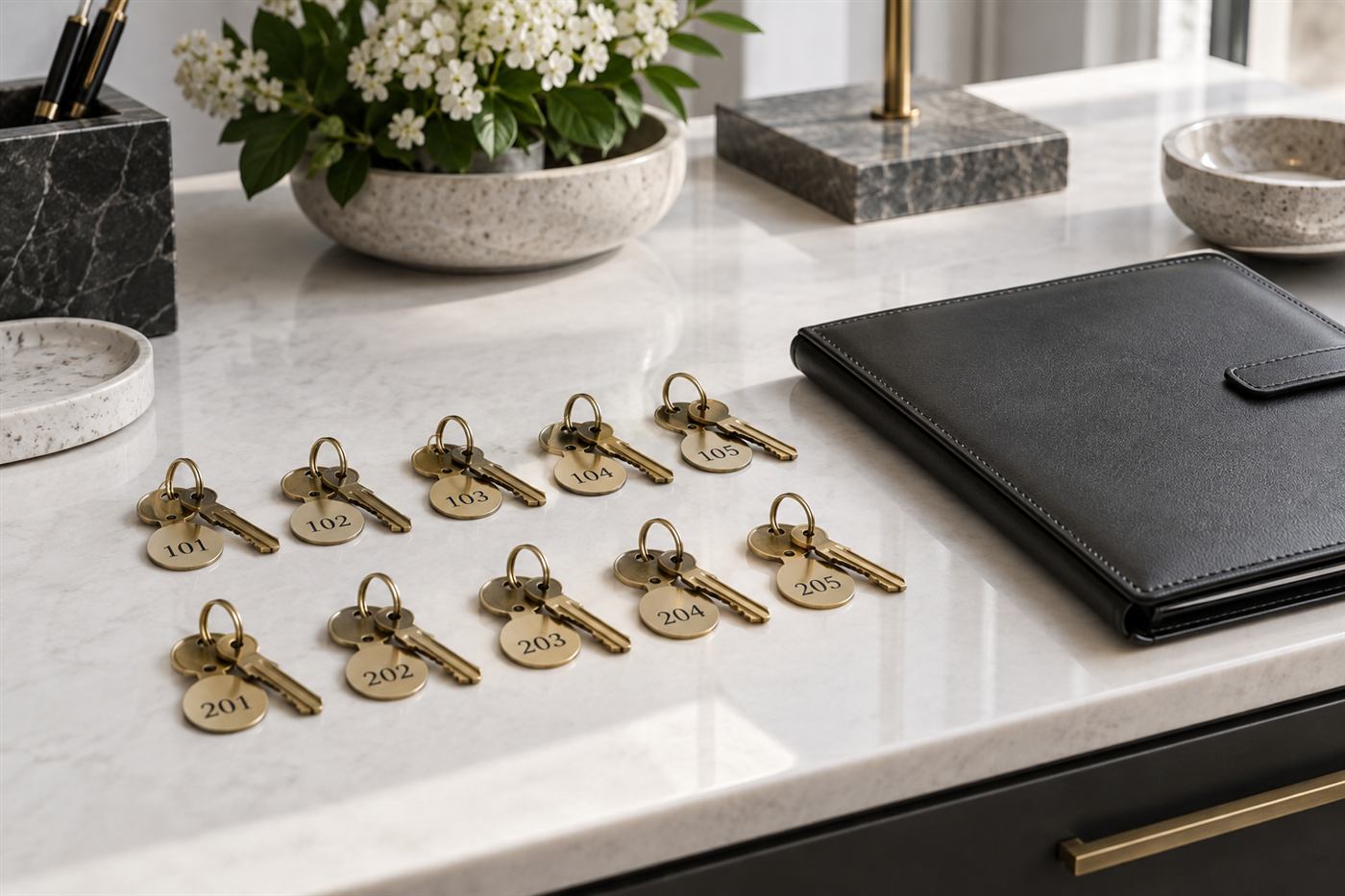
Before you label or reorganize anything, collect every key you can find. Check drawers, jackets, glove boxes, tool chests, kitchen jars, desk trays and the hook by the door. Lay them out on a table. You will probably find keys nobody can identify, and that is the most useful discovery of the whole exercise.
Go door by door and try each key. Mark the ones that work, the ones that do not fit anything and the ones you are unsure about. For a key that opens a lock but does not seem to be used, ask whether it is still needed. For a key that matches nothing, consider whether it belonged to a former home, a car you sold or a lock that was changed. Unknown keys are not necessarily dangerous, but there is little point in keeping them in the same bundle as live ones.
Write down what you find in a simple list: the door or lock, how many keys exist, and who holds each. A notebook or a note on your phone is enough. For a landlord or a business, a spreadsheet is better. Our guide for landlord lock responsibilities covers the records property owners usually want.
- Gather every key from every drawer, jar and jacket
- Test each one at each lock and note what it opens
- Separate live keys from unknown or obsolete ones
- Record the door, the number of keys and who holds each
- Decide what to keep, what to retire and what to replace
Labels that help you without helping a thief
Labels are the heart of any key system, and they carry a trap. A tag that says the full home address, the apartment number or the name of the business tells whoever finds the key exactly where to use it. A lost ring with a home address on it is a gift to the wrong person. Do not put your address, your name together with an address, or a clear description of the building on a key tag.
Use a private system that only you understand instead. Colored caps, a short letter, a number, a symbol or a small tag that means something to you but not to a stranger all work. A key marked with a green cap and the letter B might be the back door. Keep the legend, a short list of what each color or letter means, somewhere separate from the keys themselves.
For car keys, avoid anything that identifies the vehicle or your home. For work keys, consider labeling by function rather than address. The principle is the same: the label should help you and be meaningless to someone who picks the key up in a parking lot. Do not stamp or engrave identifying details into the key itself.
Key rings, hooks and a home base
Keep your everyday keys on a ring you can handle, with only the keys you really need. A heavy bundle wears out ignition cylinders and door locks over time, because the weight pulls on the key as it turns. Take off keys you rarely use and store them elsewhere. A slim ring with a few labeled keys is easier to manage and puts less strain on the locks.
Give every set of keys a home. A hook by the door, a small tray, a key cabinet or a drawer with dividers all work. The point is that keys always return to the same place, so you do not have to think about where they are. A habit of putting keys in the same spot when you arrive prevents the majority of lost-key panics.
Spare keys deserve their own home. Keep them together in a labeled envelope, a small safe or a lockable box, and note how many exist for each lock. Keep spares out of sight from visitors and contractors. A house where guests can see a board of labeled keys is a house where someone can take a single key and nobody will notice until it matters. Our guide to lockboxes and key safes covers more secure options.
Hiding places to avoid
It is tempting to leave a spare outside so you cannot be locked out. Please do not. The familiar places, such as under the mat, on top of the door frame, in a planter, under a rock, inside a fake rock, in the mailbox or on a nail behind the meter, are the first places anyone checks. People who break in are well aware of them. Our page on why hiding a spare key fails goes into detail.
Hiding a key in a car is equally risky. A spare in the glove box, the console or a magnetic box under the bumper turns a stolen car into a stolen car plus access to your home if the registration or paperwork shows an address. Do not leave a house key in a vehicle, and do not leave a vehicle key in the house where it can be taken in a quick entry.
The better option is to give a spare to someone you trust who lives nearby, or to use a proper lockbox with a strong body and a combination that you control. If you choose a lockbox, mount it so that it cannot simply be carried away, and change the combination from time to time, especially after a visitor or a contractor has used it.
Key handoffs to cleaners, sitters and contractors
Every time you give a key to another person, you add a line to the list. Cleaners, dog walkers, house sitters, pool service providers, painters and repair crews often need access. A few simple habits keep this manageable. Record who has a key, when it was given and when it was returned. Give the person a spare, never your only copy. Ask that the key not be labeled with your address.
For short projects, consider a lockbox or a keypad lock with a temporary PIN rather than a physical key. When the work is finished, change the combination or remove the PIN, and the access ends cleanly. For long-term helpers, think about whether they really need a key to the whole house or just to one door. A key that opens only the side entry is less risky than one that opens everything.
Seasonal and vacation properties raise the stakes. A key left with a neighbor, a property manager or a rental guest can circulate for months. Our page on vacation rental lock solutions explains how owners keep access under control. If you cannot be sure where all the keys are after a handoff, it is reasonable to rekey.
Condos, rentals and shared properties
In multi-unit buildings the picture is more complicated. You may hold keys to your unit, a mailbox, a storage cage, a bike room, a pool gate and a fob for the lobby. Each is a separate permission. Keep them labeled with private codes, and keep the fobs and key cards in a place where you will notice if one is missing.
Landlords and property managers should keep a master list of every key and fob issued to each tenant, with dates. When a tenant moves out, rekeying the unit is the cleanest way to be sure the old keys no longer work. Our page on apartment turnover rekey describes how that is done, and post move-in rekey is relevant for new owners.
Condo associations in Boca Raton, Delray Beach and Pompano Beach often hold a copy of unit keys or control the building master. Know what your building does and what is recorded. If an association loses a key, ask what the policy is for rekeying. Our page on condo key control explains common arrangements.
When a key goes missing
A lost key is not automatically an emergency, but it should trigger a quick decision. Ask whether the key could have been identified with an address. Ask whether it was lost near your home, in a public place or on a trip. Ask who might have found it. If the answers suggest someone could realistically trace and use the key, rekeying the lock is a sensible step and is usually quicker than replacing the hardware.
If the key was lost in your own house, search carefully for a few days before acting, and keep the lock in mind. If a stolen wallet or bag contained both keys and identification, treat it as urgent. Our page on stolen keys or wallet covers that case.
Whichever way you go, update your list. Note the key that is gone, the date, what you decided and what you changed. If you rekey, throw away or return the old keys so that old and new do not mix. A short note now saves confusion months later.
A simple system you can set up this week
Pull the pieces together into a short routine. Collect and test every key. Keep a written list with private labels. Slim your everyday ring. Give every set a home. Keep spares together, counted and out of view. Record every handoff. When a key goes missing, decide quickly whether to rekey.
If you want help, a locksmith can rekey several locks to one key so you carry fewer keys, label the new keys and tell you how many copies exist. Our page on keyed-alike locks explains that option. It is a tidy way to reduce the bundle you carry while keeping every door secure.
When you are ready, call and describe what you have: how many doors, what kind of locks, how many keys are in circulation and what worries you. You will hear how the quote works, how the service call charge is handled and whether a larger job needs an on-site look before a figure can be agreed.
Questions people ask
Should I label my keys with my address?
No. A tag with your address tells whoever finds a lost key exactly where to use it. Use a private system instead, such as colored caps, letters or numbers that only you understand, and keep the list that explains them somewhere separate from the keys themselves.
Is it safe to hide a spare key outside?
Generally no. Under the mat, in a planter, on the door frame or in a fake rock are the first places anyone looks. A better choice is to leave a spare with a trusted person nearby or to use a proper lockbox that you control and mount securely.
How many keys should be on my everyday ring?
Only the ones you use regularly. A heavy bundle pulls on ignition and door cylinders and wears them over time. Keep rarely used keys in a labeled spot at home. A slimmer ring is easier to manage and easier on your locks.
When should I rekey instead of just replacing a lost key?
If the lost key could realistically be traced to your home, or if you are unsure who has copies, rekeying is a sensible way to make old keys useless. It is often quicker than replacing hardware. If the key was lost in your own home, search for a few days first.
How should I handle keys for cleaners and contractors?
Record who has a key and when it was given. Give a spare, not your only copy. Consider a keypad lock or a lockbox with a temporary combination for short jobs, and change it afterwards. If you cannot account for a key after a handoff, rekey.
Can several locks be made to use one key?
Yes. A locksmith can rekey locks to match, called keyed-alike, so one key opens several doors. That reduces the bundle you carry. It works best when the locks are compatible, and a technician can tell you what is possible after seeing the doors.
Describe the situation by phone and we will tell you what the job involves. Quotes are given by phone. Jobs that cannot be quoted without seeing them need a technician on site, and the service call charge is explained on the phone before anyone is dispatched.
(954) 906-9567Related pages
Building a spare key map
An inventory tells you what you own; a map tells you where each thing is and who can reach it. Draw a simple grid on one sheet of paper with doors down the left side and columns for copies across the top: your set, the household member set, the trusted neighbor, the cleaner, the car, and the safe. Fill in a mark for every key that exists. This exercise often shows something uncomfortable, such as five copies of the back door key floating around while the garage entry has only one, and no one is sure where it is.
Keep the map somewhere that is not the front hall wall. A folder with your important household papers works well, and a photo on your phone gives you a second copy. Do not put a street address on it, and do not write which key opens what in a way that would help a stranger who finds the sheet. Short codes work: D1, D2, and so on, with the legend stored separately. The point is for you or a family member to answer the question of who has what in under a minute.
Update the map whenever anything changes, including small events like lending a key for a weekend. Add a date and initials next to the line. Once a year, run through it against the keys you can physically gather. Missing entries are the useful discovery, since they show which doors deserve a closer look. If a key in the column of a former contractor or tenant is still out there, that is the moment to consider re-keying rather than hoping the key stays forgotten. Older block homes, newer townhomes and high-rise condominiums in the area each behave a little differently, so describe your own building plainly.
Keeping the system alive after the first month
Most organizing systems work well for about a month and then slip, so build in habits that cost almost nothing. Choose one spot where keys land when you walk in, and make it the only spot. A hook inside a closet door near the entry is better than a bowl on a counter, because it keeps keys out of view from windows. Place a small tag or colored cap on each rarely used key, so you recognize it by feel as well as by sight when you are standing in the dark or in the rain.
Teach everyone in the home the same routine, children included at an age-appropriate level. Agree on a rule that keys never stay in a bag on the floor or in a coat pocket overnight. After guests or work crews have been through the house, count the keys and check the hooks before going to bed. This sounds fussy, but the habit takes seconds and catches the commonest failure, which is a key walking out of the house in someone else's pocket without anyone noticing. Nothing here needs special skill, only patience and a willingness to stop when something does not feel right.
Finally, plan for the moment the system is tested. If a key is lost, you want to know within a minute which doors are affected and whether the key carried any identifying tag. A locksmith can talk through whether replacement of one cylinder is enough or whether the whole set should be re-keyed to a single new key. The scope and any quote are explained before work begins, and a clear map makes that conversation faster and calmer. A photo taken before you touch anything makes it much easier to put things back and to explain the situation to someone else.